

There are moments when life changes shape before we’ve found language for what’s happened.
A diagnosis alters the map. Someone we love changes what matters. Grief unsettles the proportions of ordinary things. Care enters the day and refuses to stay neatly contained.
What arrives may be wanted, feared, beautiful, painful, or all of those at once.
The question isn’t simply how we adapt.
It’s what happens to us as we do.
A book to spend time with
This isn’t writing designed to be consumed at speed.
Ideas gather gradually. A story may open a question without closing it. One passage might become clearer only after the reader has left it for a while.
Several early readers have described returning rather than simply moving forward. That feels right.
There are books we read to reach the end.
Others work differently.
They accompany us for a distance, leave something unfinished, then reappear when life gives the words a different meaning.
Read slowly enough for something to answer back.
How do we let life change us without losing the part of ourselves that can still choose what to do with what arrives?
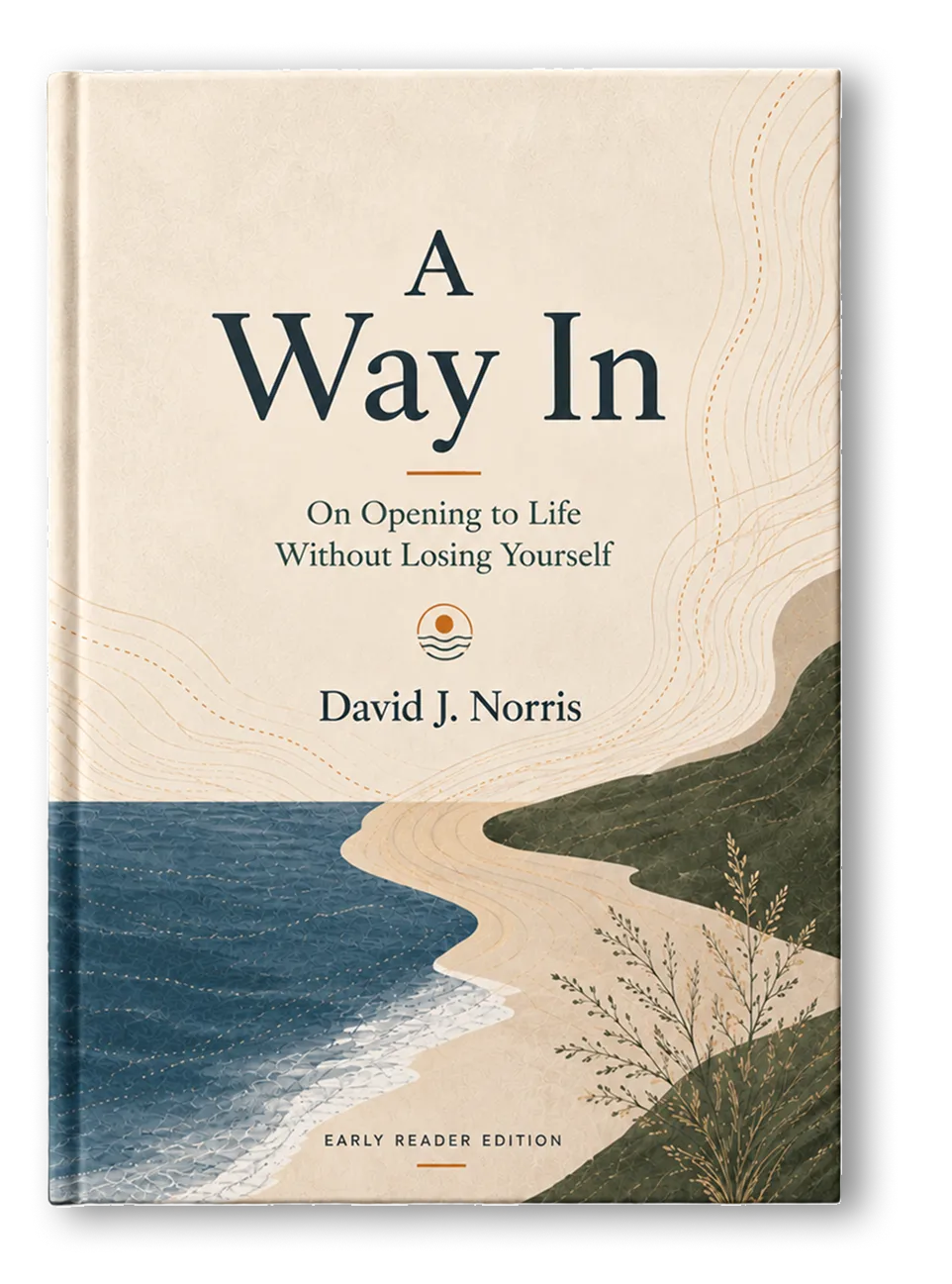
A Way In stays close to that threshold.
It doesn’t offer a system for mastering change. The writing moves through lived experience, observation and reflection, looking for the moments when something that felt closed begins to reveal another way through.

Before the Door
From the draft manuscript
Some thresholds announce themselves. Others only become visible once we’re already standing on the other side.
A conversation can leave the room altered. Illness divides time into before and after. Love changes the weight of things we thought were settled. Occasionally, the life we asked for arrives and proves larger than the person who first imagined it.
We tend to think the important decision is whether to open the door.
Often, the harder work begins after we have.
What should be allowed to enter deeply enough to change us? Where does openness become surrender? How do we remain responsive to another person without handing over the whole territory of ourselves?
Those questions rarely arrive as clean dilemmas. They appear in kitchens, hospital rooms, bedrooms, workplaces, waiting rooms and the quiet spaces after something has happened that can’t be undone.
A
Way In
begins there.
— "Before the Door", from the manuscript of A Way In (v1.8)
Not everything that changes us should own us.
Openness is easy to admire from a distance. We speak of being more available to experience, more honest in relationship, more willing to feel. It sounds expansive, almost unquestionably good.
Come closer and the picture becomes less simple.
To care deeply is to let another person matter enough to alter the shape of our days. Love rearranges priorities we once thought were settled. Illness can pull attention towards the body until the body begins to define the horizon. Even hope has weight when something we want starts asking more of us than we expected to give.
None of that makes openness a mistake.
It makes discernment necessary.
Life will change us. The more difficult question is how to remain available to what arrives without surrendering the inner ground from which we can still choose, refuse, return and recognise ourselves.
To be changed without being given away.
The book lives inside that tension.
A Way In moves through moments when the old shape of a life no longer quite fits.
Sometimes the change is obvious. At other times it gathers quietly until we realise the person who entered a season of life isn’t quite the person standing at its other edge.
The writing isn’t interested in forcing those moments into lessons too quickly. Experience often knows something before we do. An image can carry a thought long before an argument is ready. Meaning may gather around an ordinary object, a conversation, a river, a room, or the particular silence left after someone has gone.
That slower movement matters.
The point isn’t to turn uncertainty into certainty as quickly as possible. It’s to stay close enough to what’s happening that another form of understanding has time to appear.
A Way In isn’t always an answer.
Sometimes it’s the place from which the question can finally be seen.
Early reader notes
A Way In is currently with its first readers. These comments are shared with permission.
“I feel seen. What a gift.”
– Benny, Queensland
“Definitely a read that needs time to soak in.”
– Anthony, Western Australia
“Your descriptions create beautiful images. The water lifts a rolling curtain from itself gives me goosebumps. It is a joy to read your work.”
– June, Queensland
“I am literally hooked from page one. You have a beautiful way with words, the flow of your writing, weaving experiences with metaphors.”
– Lisa, Western Australia
“You hold the idea and never lose it, and by the end you realise, that is what it was.”
– Jelenko, Queensland
Be told when the door opens.
A Way In is still being shaped.
New passages will appear as the manuscript develops. There will also be opportunities to read early work and, in time, news of publication.
If you’d like to stay close to the book as it forms, leave your email below.
Follow A Way In
Only updates connected to the book and David’s writing.

The wider inquiry
A Way In sits beside The Brain Commons, though each begins from a different side of the person
The Brain Commons looks outward. It asks how work, care, technology, institutions, relationships and environments shape whether people retain enough room to think, judge and act.
This book turns towards what happens when change crosses the boundary of the self.
Life doesn’t only surround us. It enters through what we love, fear, lose, attend to and become responsible for. Once that happens, agency is no longer only a question of what the world allows.
A more intimate question appears:
What must remain within us if we’re to be changed without losing the ground from which we still choose?
That is where the two bodies of work meet.
One examines the world around the person.
The other stays with the person being changed by that world.
Together, they ask what allows human agency to remain alive under conditions we don’t fully control.



