ESSAY
The Brain Commons
The founding essay. A lens on the shared conditions through which attention, judgement, relationship, participation, care and agency become possible — and through which they can also be narrowed, depleted or enclosed.
·
September 9, 2026
·
8
min read
·
Notes on Human Agency (Substack)
Central Proposition
Human agency does not arise in isolation. It is the lived, relationally arising capacityto judge, respond, refrain, and participate meaningfully in the world. It is real in theperson, but never privately produced.
Agency is formed within ecologies: the relationships, places, technologies,institutions, histories, rhythms, and obligations through which people come to notice,make sense, care, refuse, act, and participate.
These ecologies are not neutral. Some create room for attention, trust, judgement,recovery, restraint, and meaningful participation. Others make agency harder tosustain. They fragment attention. They compress judgement. They burden care. Theythin trust. They make pause, refusal, and sustained thought harder to hold. They leavepeople trying to remain clear, steady, and responsible within conditions that workagainst them.
This is the contradiction now pressing across care, work, education, family life,technology, and civic participation. Contemporary life depends on people being ableto think clearly, regulate themselves, care for others, judge wisely, refrain whenneeded, and participate meaningfully, while many of the conditions around themmake those capacities harder to hold.In the age of generative AI, this concern can no longer remain at the margins. Theconditions shaping attention, judgement, trust, imagination, authorship, work ,learning, care, refusal, and participation are being redesigned in real time, at scale,often before we have developed the language, institutions, or shared practices tounderstand what is being altered.
The failure is not that we care for individuals. The failure is that we often care forindividuals while leaving untouched the ecologies that keep producing the need forcare.
This paper introduces the Brain Commons as a way of seeing and stewarding thatshared terrain: the field through which human agency is shaped, strained, captured,protected, or restored.
Executive Summary
Human agency is increasingly being treated as an individual responsibility while theconditions shaping it remain under-examined.
Across care, work, education, family life, technology, and civic participation, we areoften quicker to name what is happening in the individual than to trace the wider fieldin which that difficulty has taken form. We can describe the symptoms, the behaviour,the burnout, the dysregulation, the disengagement. We are less practised at askingabout the field around that strain: the environments people inhabit, the rhythms andexpectations they are living within, and the relations that either support or erode theircapacity to respond.
This is not simply a gap in compassion. It is a gap in perception. The visible burden isoften individuated before the field is understood.
When a child struggles, the focus may land on the child before it reaches theclassroom rhythm, sensory environment, learning design, family pressure, or widersystems moving through that childʼs day. When a worker is exhausted, the focus mayland on resilience or mental health before it reaches workload, interruption,managerial design, time poverty, relational strain, or the design of work itself. When afamily is overwhelmed, the focus may land on family functioning before it reacheshousing pressure, administrative complexity, care burden, institutional fragmentation, or the cumulative abrasion of trying to live within systems that do notjoin up.
These individual responses are not always wrong. Often they are humane, necessary,and urgent. The person must be seen. But when the field remains under-seen, theburden keeps being reproduced. The person returns to the same conditions, and theintervention is asked to do more than it can hold.
This paper begins with a more disciplined doubleness of vision: to see the personclearly, and to see the field more truthfully. That doubleness is only the entry point.Once the person and field are held together, a more complex ecology comes into view:relations, histories, technologies, institutions, rhythms, incentives, and places allmoving at once. What is needed is not a fixed map, but an observational lens and anavigating compass for a dynamic terrain.
The aim is not to look past the individual, nor to dissolve responsibility into abstractsystems. It is to recognise that human agency is not held by the individual alone.
Human agency is not isolated independence. It is the lived capacity to judge, respond,refrain, and participate meaningfully in the world, formed through relation andshaped by conditions no person creates alone. It is lived in persons, but neverprivately produced. Agency includes action, but it is not reducible to visiblemovement. It also lives in pause, restraint, refusal, care, and the capacity to remainmeaningfully present to what is being asked.
Because agency is formed through relation and conditions, it is also vulnerable tothem. It can be supported, strengthened, and drawn forth. It can also be driven,captured, manipulated, exhausted, or redirected.
The Brain Commons gives language to this shared field. It is not a metaphor for thebrain alone, nor a list of individual capacities. It points to the relations and conditionsthrough which agency finds room to take form — or is narrowed, burdened,redirected, and diminished.
To speak of a commons is to recognise that these conditions are shared, vulnerable,consequential, and not infinitely self-renewing. They can be depleted. They can beenclosed. They can be extracted from. They can also be stewarded.
The commons introduces obligation without collapsing into moralism. Where agencydepends on shared conditions, care cannot stop at the individual carrying the visibleburden.
The person must remain visible. The field must become answerable. The relationsbetween them are the work of stewardship.

WHERE THIS SITS
The Brain Commons
This essay belongs to The Brain Commons — a lens on the shared conditions that sustain or deplete human agency.


What Are We Building Towards When We Build Brain Capital
Individual capacities are real. But they are not privately produced, and they cannot be protected by asking individuals alone to adapt. The central claim of the work, made at human scale.
Where Will Judgement Live?
On AI and persuasion — and on flattery, the most intimate and least visible form of cognitive capture: a machine returning a sharpened image of your own thinking, faster than you could make it yourself.
Essay 02
What Are We Building Towards When We Build Brain Capital
An offering to the brain-capital movement on agency and the conditions through which capacity becomes action
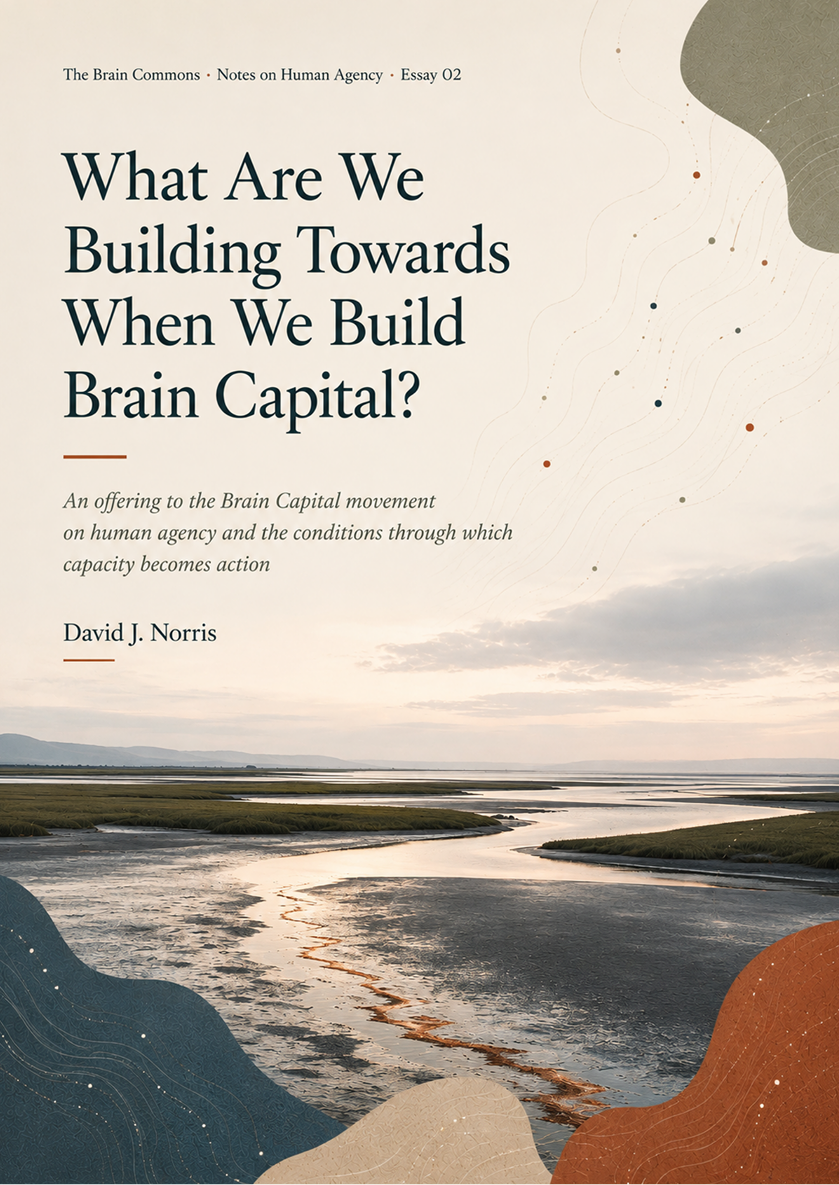
Brain-capital language has opened doors that needed opening. This essay asks what else must be protected: the shared conditions through which capacity becomes participation, judgement and action.
Essay 03
Where Will Judgement Live?
AI, work, and the governance of capability
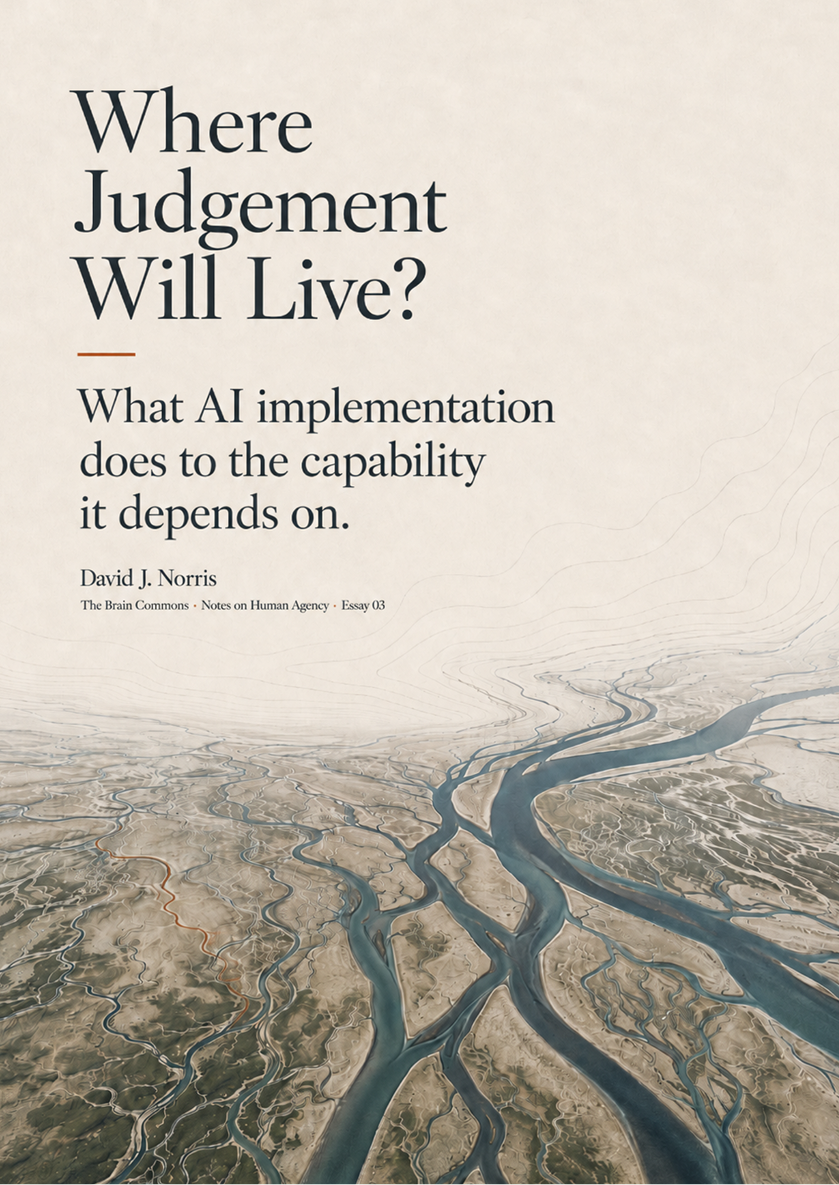
Every substantial AI implementation is also a redesign of the institution’s cognitive architecture. This essay asks what happens to human judgement, expertise and agency when system capability rises — and what institutions should be able to account for.
The conversation around this essay continues on
Notes on Human Agency


Human capability, agency, attention, care and the conditions that shape us.
Brisbane, Australia
THE WORK
CONNECT
ELSEWHERE
This work is written on the lands of the Turrbal and Yagara peoples. I acknowledge their custodianship of Country and their elders past and present, and the truth that the conditions I write about — attention, care, participation, stewardship — have been practised on these lands for tens of thousands of years.
© David J. Norris 2026. All rights reserved.

