ESSAY
What Are We Building Towards When We Build Brain Capital
Brain-capital language has opened doors that needed opening. This essay asks what else must be protected: the shared conditions through which capacity becomes participation, judgement and action.
·
September 9, 2026
·
12
min read
·
Notes on Human Agency (Substack)
Executive summary
The convening of the Nature Medicine Commission on Brain Health for Economic Resilience creates a for‐mative opportunity to consider how measured capacity becomes participation. This essay enters thatwork from clinical and service-design practice and offers one distinction for consideration: betweenthe capacities a person or population holds and the practical conditions through which those capacitiesbecome action.
Its argument turns on a single line: agency is personally enacted, but never privately created. Measuredcapacity — Brain Health, Brain Skills — becomes participation only through enactment, and enactment de‐pends on conditions that are shared rather than owned: time, authority, coordination, and the room tojudge. These conditions form a commons, the Brain Commons, which can be tended or left to thin. TheBrain Capital architecture already holds them centrally, in its Brain Enabler domain; agency is present in thedirection of the model, but it is not yet distinguished analytically from capacity, enabling conditions andoutcome. Health measurement already makes the neighbouring distinction. The ICF separates what a per‐son can do from what they do in their own setting. The essay lays that precedent beside the model andlets the correspondence stand.
An apparatus carries the formal weight, meant to be read as reasoning made available for scrutiny ratherthan as ornament. It draws the enactment relation within a reciprocal model (Figure 1); holds the same con‐ditions of enactment at population and institutional level in two companion tables — one naming what totrack, the other the questions stewardship must keep asking — and sets out six propositions, each statedso it could be found false, each with its present evidential footing and the inquiry that would test it. Thedistinction itself is not new coinage: it is drawn from established work — the Global Brain Capital Index andDashboard, the World Health Organization’s International Classification of Functioning, the capability ap‐proach, and commons governance — and is offered here to be examined, tested and, where it fails, re‐vised. Its practical hinge is plain: measurement lets us see the foundation; stewardship is why we tend it;investment and stewardship are different instruments, doing different work.
The essay closes where it began. If agency is the meeting between a capacity and the conditions of itsacting, then a society seeking to strengthen brain health cannot attend only to the capacities people hold;it must also tend the shared conditions through which those capacities become action, and keep a floorowed regardless of what those conditions return.
Where this begins
For much of modern economic measurement, the mind appeared indirectly: through labour, education,productivity or illness, but rarely as a set of capacities a society might deliberately protect and develop.The Brain Capital movement has begun to change that. It has carried health, cognition and skill into therooms where budgets are set, and it has done so with seriousness and care.
I write from closer, in my daily work, to the single person than to the population. From that vantage point,one observation has become increasingly clear. A person may be regarded as the author of their actions.Judgement, choice and the pause before harm are lived through one body and one life, even when theyare supported by others.
Yet the conditions that make those acts possible are not held inside the person. The time to think, the safe‐ty to speak, the room to decide and the pace that still allows care are created between us. They are moreshared than our usual measures tend to acknowledge.
That is the whole of it, and I will spend the rest of this essay turning it slowly in the light. But I want thesentence to stand on its own first, before any evidence arrives to keep it company, because everythingelse follows from it:
Agency is personally enacted, but neverprivately created.
This essay offers a distinction for consideration while the measurement architecture is still forming. It askswhether the relationship between Brain Enablers, Brain Health and Brain Skills might also be read throughthe question of agency: under what conditions does capacity become action?

WHERE THIS SITS
The Brain Commons
This essay belongs to The Brain Commons — a lens on the shared conditions that sustain or deplete human agency.


What Are We Building Towards When We Build Brain Capital
Individual capacities are real. But they are not privately produced, and they cannot be protected by asking individuals alone to adapt. The central claim of the work, made at human scale.
Where Will Judgement Live?
On AI and persuasion — and on flattery, the most intimate and least visible form of cognitive capture: a machine returning a sharpened image of your own thinking, faster than you could make it yourself.
Essay 01
The Brain Commons
Human agency, shared stewardship, and the ecologies that shape us
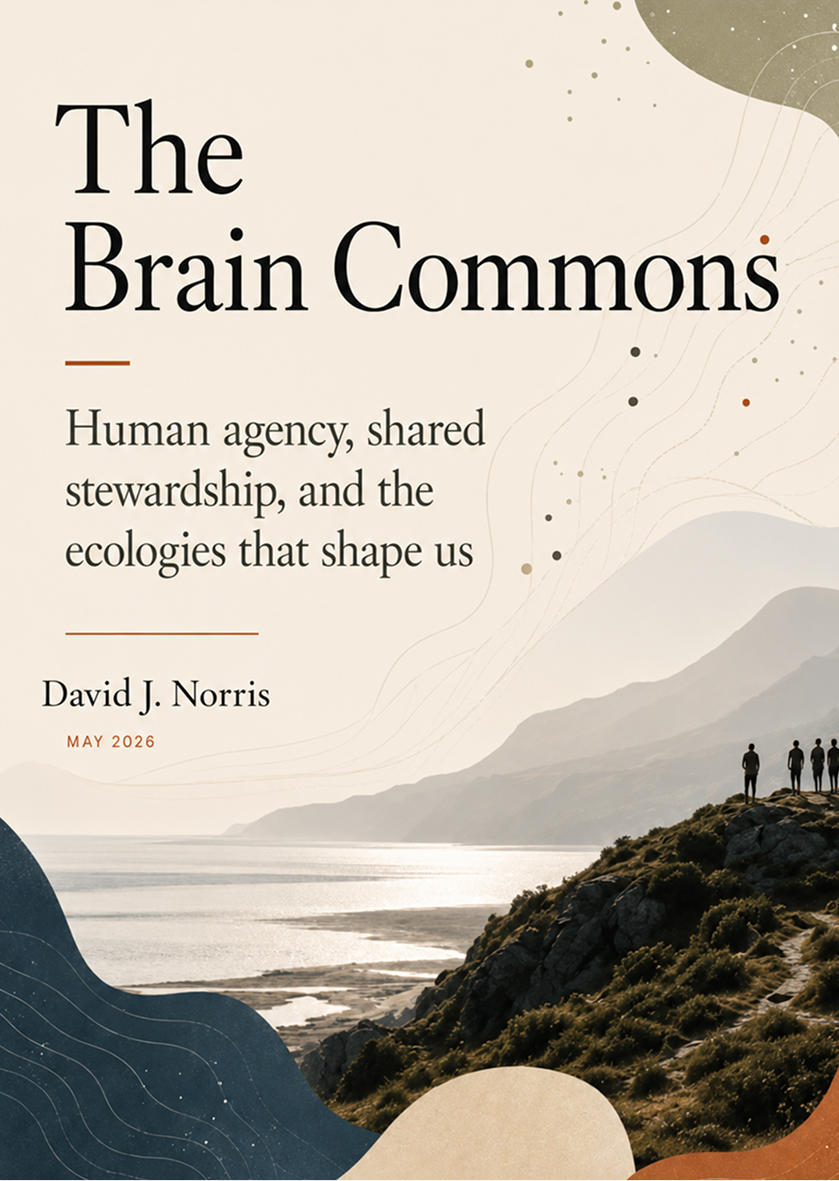
The founding essay. A lens on the shared conditions through which attention, judgement, relationship, participation, care and agency become possible — and through which they can also be narrowed, depleted or enclosed.

Essay 03
Where Will Judgement Live?
AI, work, and the governance of capability
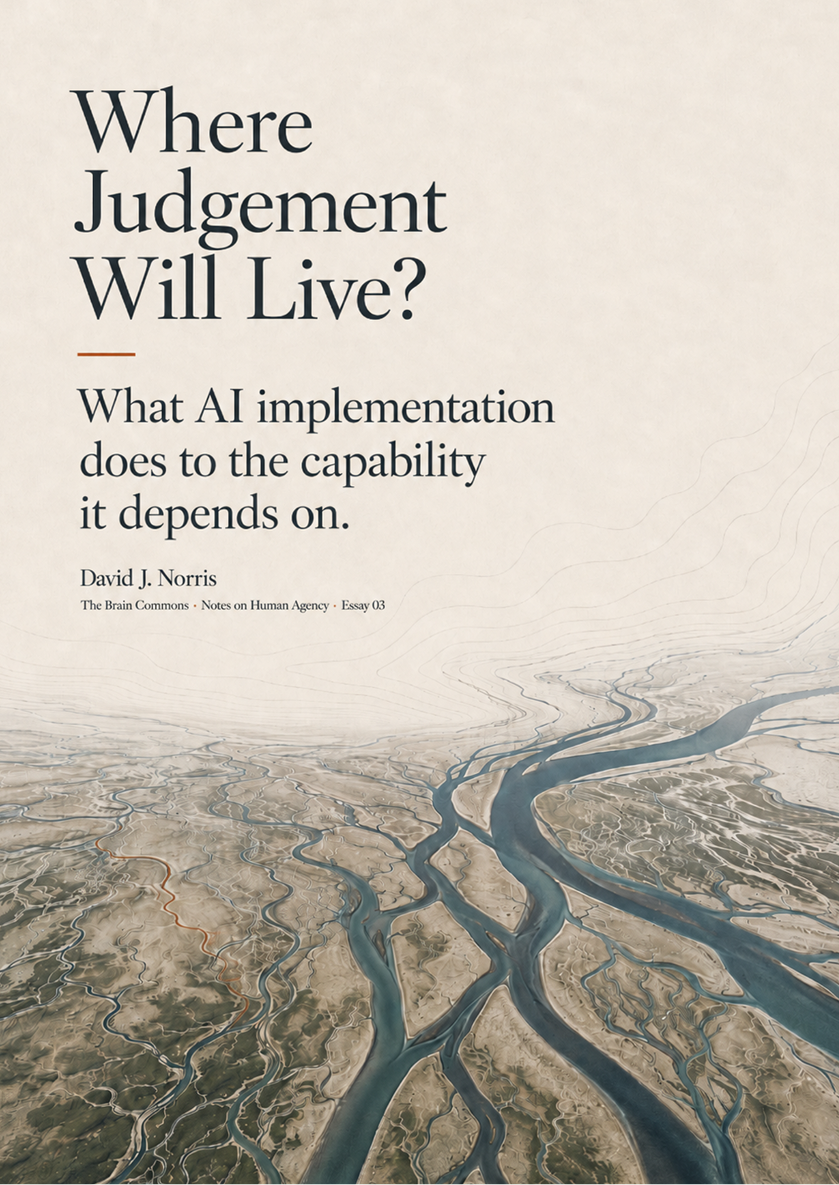
Every substantial AI implementation is also a redesign of the institution’s cognitive architecture. This essay asks what happens to human judgement, expertise and agency when system capability rises — and what institutions should be able to account for.

The conversation around this essay continues on
Notes on Human Agency


Human capability, agency, attention, care and the conditions that shape us.
Brisbane, Australia
THE WORK
CONNECT
ELSEWHERE
This work is written on the lands of the Turrbal and Yagara peoples. I acknowledge their custodianship of Country and their elders past and present, and the truth that the conditions I write about — attention, care, participation, stewardship — have been practised on these lands for tens of thousands of years.
© David J. Norris 2026. All rights reserved.

